
Buy D6 Diesel Fuel in Bulk: Everything Importers Need to Know
Latest Posts
-
-
-
Partnering with a Reliable EN590 Diesel Exporter
28 Feb 2026
03 Mar 2026
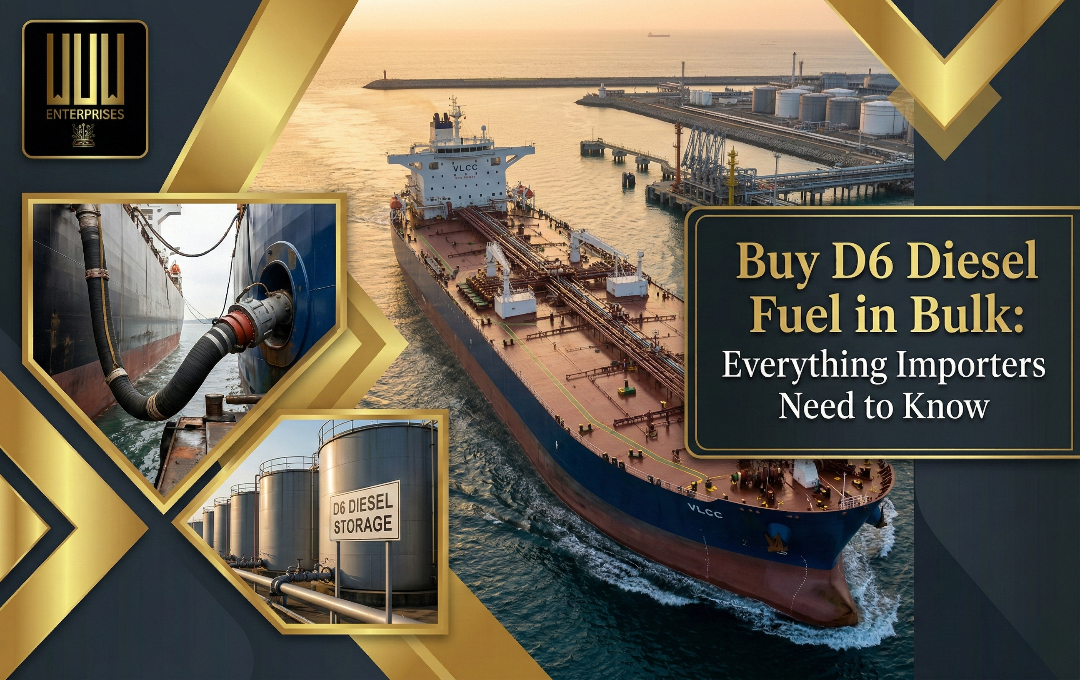
Buy D6 Diesel Fuel in Bulk: Everything Importers Need to Know
Introduction: The First Time I Looked Into Buying D6 Diesel Fuel in Bulk
When I first explored sourcing D6 Diesel Fuel in bulk, I assumed it was just diesel at scale. It wasn’t.
Within days, I realized I wasn’t buying road diesel — I was stepping into the world of residual fuel oil, bunker contracts, sulfur regulations, refinery allocations, and documentation layers thick enough to derail a shipment before it ever touched a vessel.
That realization matters more today than ever.
The global fuel oil market reached approximately USD 195.8 billion in 2024 and is projected to climb to nearly USD 273.8 billion by 2033, growing at a steady CAGR of about 3.9%. The bunker fuel segment alone stands at roughly USD 136 billion in 2025, expected to exceed USD 202 billion by 2030. Globally, bunker fuel trade is estimated at 700 million metric tons annually — nearly 197 billion gallons moving through ports, terminals, and shipping lanes.
If you’re planning to import D6 Diesel Fuel, you’re not just buying energy — you’re entering a regulated, high-value global commodity market where compliance and execution determine profit or loss.
This guide is for serious importers.
For buyers evaluating refinery-level supply.
For businesses navigating compliance, documentation, and risk in bulk fuel import transactions.
Let’s break it down properly.
What D6 Diesel Fuel Actually Is (And What It Is Not)
Technical Definition of D6 Diesel Fuel
D6 Diesel Fuel is commonly referred to as residual fuel oil (RFO) or heavy fuel oil (HFO). It is derived from the bottom fraction of crude oil distillation — the dense, high-viscosity residue left after lighter distillates are removed.
Unlike automotive diesel, D6:
- Is highly viscous
- Requires heating before combustion
- Is primarily used in marine engines and large industrial facilities
It falls under internationally recognized specifications such as the ISO 8217 marine fuel standards, which govern quality benchmarks in maritime applications.
Core Physical Characteristics Importers Must Understand
Before signing any contract, specifications must be crystal clear. Typical properties include:
- Viscosity range: 180–380 cSt (e.g., IFO 180, IFO 380)
- Density at 15°C: 0.91–0.97 kg/L
- Flash point: ≥60°C
- Sulfur content:
- Traditional high sulfur fuel oil (HSFO): up to 3.5% sulfur
- Low sulfur (LS) or ultra-low sulfur variants for stricter jurisdictions
In commodity discussions, confusion often arises between D6 Diesel Fuel and marine gasoil (MGO) or marine diesel oil (MDO). They are not interchangeable. MGO is a lighter distillate fuel. D6 is a heavy residual product. If your contract does not explicitly define viscosity grade and sulfur specification, you are exposed to disputes.
Clarity at this stage prevents expensive misunderstandings later.
Where D6 Diesel Fuel Is Actually Used (And Why That Matters)
Marine Sector – The Bunker Fuel Backbone
The largest application for D6 Diesel Fuel is as bunker fuel powering:
- Oil tankers
- Container vessels
- Bulk carriers
Outside strict Emission Control Areas (ECAs), heavy fuel remains widely used. Many scrubber-equipped vessels continue to operate using higher sulfur grades while remaining compliant.
The bunker fuel market’s projected growth beyond USD 202 billion by 2030 reflects continued structural shipping demand. Global trade depends on marine transport — and marine transport depends heavily on bunker fuel.
Industrial Power Generation & Utilities
Beyond maritime use, industrial fuel oil applications include:
- Large-scale generators
- Steel and cement plants
- Chemical manufacturing facilities
- Boiler and steam production systems
Industrial buyers often evaluate cost per thermal output. Heavy fuels can be economically attractive — but only when infrastructure is in place. Heated storage tanks, temperature-controlled pumping systems, and specialized handling are not optional.
What D6 Diesel Fuel Is NOT Used For
Let’s eliminate assumptions:
- Not for passenger vehicles
- Not for light-duty engines
- Not suitable for small marine vessels
Importing D6 without understanding its intended end use can create compliance and operational issues.
Global Market Landscape: Where the Real Trade Happens
Market Size and Growth Trends
The global fuel oil market continues to expand:
- USD 195.8B (2024)
- Projected USD 273.8B by 2033
- CAGR: ~3.9%
Despite energy transition narratives, heavy fuels remain commercially relevant. Shipping demand and industrial heat requirements sustain global consumption.
The bunker segment, currently around USD 136B, is forecast to surpass USD 202B by 2030. The scale of this market signals continued relevance for D6 Diesel Fuel.
Trade Volume & Geographic Flow
Approximately 700 million metric tons of bunker fuel trade annually.
Major export regions:
- Russia
- United States
- Saudi Arabia
Major importing hubs:
- China
- Singapore
- India
Strategic bunkering centers include Houston, Rotterdam, Singapore, and Fujairah.
Asia-Pacific industrial expansion continues to anchor long-term demand patterns. Geography, port infrastructure, and regulatory environments significantly influence pricing and contract structure.
Regulatory & Compliance Framework: The Non-Negotiable Layer
Many first-time importers underestimate this layer.
IMO 2020 Sulfur Cap
The IMO 2020 sulfur rule reduced the global sulfur cap to 0.50% for marine fuels. Stricter limits apply within Emission Control Areas.
This regulation reshaped supply dynamics, increasing demand for compliant grades while creating pricing differentials between HSFO and low-sulfur alternatives.
Importing high-sulfur D6 Diesel Fuel into restricted jurisdictions without proper allowances can result in fines, cargo rejection, or forced re-export.
ISO 8217 Marine Fuel Standards
Contracts should explicitly reference ISO 8217 marine fuel standards. These define fuel quality benchmarks and protect buyers from substandard deliveries.
Transport & Liability Rules
Compliance extends beyond sulfur content:
- Bunker Oil Pollution Damage Convention
- IMDG & SOLAS transport regulations
- Mandatory MSDS documentation
This is not “just diesel.” Compliance clauses shield you from multi-million-dollar exposure.
Bulk Purchasing & Import Logistics: How Deals Actually Work
Minimum Order Quantities
Listings commonly start at 50,000 MT or refinery-scale volumes. Smaller quantities often involve intermediaries or secondary markets.
Pricing Structure
Pricing for D6 Diesel Fuel typically links to crude benchmarks and refining margins. Sulfur content impacts premiums or discounts.
Indicative FOB Middle East pricing has ranged around $0.79–$0.87 per gallon depending on grade and timing — but FOB fuel pricing is only part of the equation.
Freight, heating requirements, port fees, and storage costs materially affect total landed cost under CIF fuel contracts or CFR terms.
Contract Structure & Payment Instruments
A legitimate bulk fuel import transaction must define:
- INCOTERMS (FOB, CIF, CFR)
- Proof of Product (POP)
- Letter of Credit (LC)
- Standby LC (SBLC)
- T/T payment conditions
- Independent inspection (SGS inspection or Intertek)
If inspection procedures and POP documentation are vague, pause. Commodity fraud risk in informal channels is very real.
Storage & Handling Requirements
D6 requires:
- Heated storage tanks
- Temperature-controlled pumping systems
- Specialized terminal infrastructure
Capital and operational costs must be factored before committing to supply.
Risk & Due Diligence: The Importer’s Survival Checklist
Supplier Verification
Before engaging in any bulk fuel import:
- Confirm refinery allocation
- Validate export licenses
- Cross-check corporate documentation
Many online listings for D6 Diesel Fuel are not backed by actual refinery contracts.
Price Volatility Risk
Heavy fuel prices track crude volatility. Long-term contracts or hedging strategies may reduce exposure for large buyers.
Regulatory Exposure
Risks include:
- Importing high-sulfur product without permits
- Customs clearance delays
- Misclassification penalties
- Environmental non-compliance
In this market, operational oversight is not optional — it is survival.
Environmental & Market Evolution: Where D6 Stands Long-Term
Energy transition pressures are reshaping demand.
Shifts toward:
- Very Low Sulfur Fuel Oil (VLSFO)
- LNG bunkering
- Biofuel blends
are influencing procurement strategies.
Scrubber technology, however, allows many vessels to continue using higher sulfur D6 Diesel Fuel, preserving part of the demand base.
The narrative isn’t that D6 is disappearing. It is evolving under regulatory and sustainability scrutiny.
Strategic Decision Framework for Importers
Before signing any D6 Diesel Fuel contract, clarify:
- Exact grade (IFO 180, IFO 380)
- Sulfur specification
- Delivery port
- INCOTERMS
- Inspection protocol
- Payment instrument
- Destination compliance requirements
Opportunities exist in:
- Asia-Pacific demand growth
- Premium pricing for low-sulfur grades
- Long-term supply agreements that stabilize margins
In a global fuel oil market exceeding USD 195 billion, execution quality determines profitability.
Frequently Asked Questions (FAQs)
What is the difference between D6 Diesel Fuel and marine gasoil (MGO)?
D6 is a heavy residual fuel oil with high viscosity requiring heating; MGO is a lighter distillate suitable for cleaner-burning marine applications.
Is D6 Diesel Fuel still widely used after the IMO 2020 sulfur cap?
Yes. It remains widely used, especially in scrubber-equipped vessels and markets outside strict ECAs.
What are typical minimum quantities for bulk D6 purchases?
Transactions commonly begin at 50,000 metric tons or refinery-scale volumes.
What documents are required when importing D6 Diesel Fuel?
MSDS, Certificate of Origin, Bill of Lading, SGS inspection report, ISO 8217 compliance documentation, and Proof of Product are typically required.
How is D6 Diesel Fuel priced?
Pricing reflects crude benchmarks, refining margins, sulfur grade, freight costs, and regional supply-demand dynamics.
What are the biggest risks in D6 Diesel Fuel import transactions?
Supplier fraud, regulatory non-compliance, sulfur misclassification, documentation errors, and price volatility.
Conclusion: Buying D6 Diesel Fuel Is a Strategy, Not a Simple Transaction
The trade in D6 Diesel Fuel operates within a global fuel oil ecosystem exceeding USD 195 billion, with nearly 700 million metric tons traded annually. Regulation, especially the IMO sulfur cap, has reshaped demand and contract structures. Compliance, documentation, inspection, and logistics coordination are not side issues — they are core components of transaction success.
Importing D6 Diesel Fuel isn’t about chasing the lowest posted price. It’s about understanding specification, regulatory exposure, logistics complexity, and long-term positioning within a shifting energy market.
For businesses navigating these layers — from refinery allocation and ISO 8217 compliance to inspection protocols and shipment execution — working with a structured, verification-first coordination partner can significantly reduce transaction risk. WVW Enterprises, LLC was built around addressing the exact breakdown points that often disrupt bulk fuel transactions: documentation gaps, unverified supply chains, and fragmented logistics coordination.
In a market where one misstep can delay cargo, freeze capital, or trigger compliance penalties, disciplined oversight and verified sourcing are not advantages — they are requirements. And in the evolving landscape of global D6 Diesel Fuel trade, strategy and execution will always outperform shortcuts.